
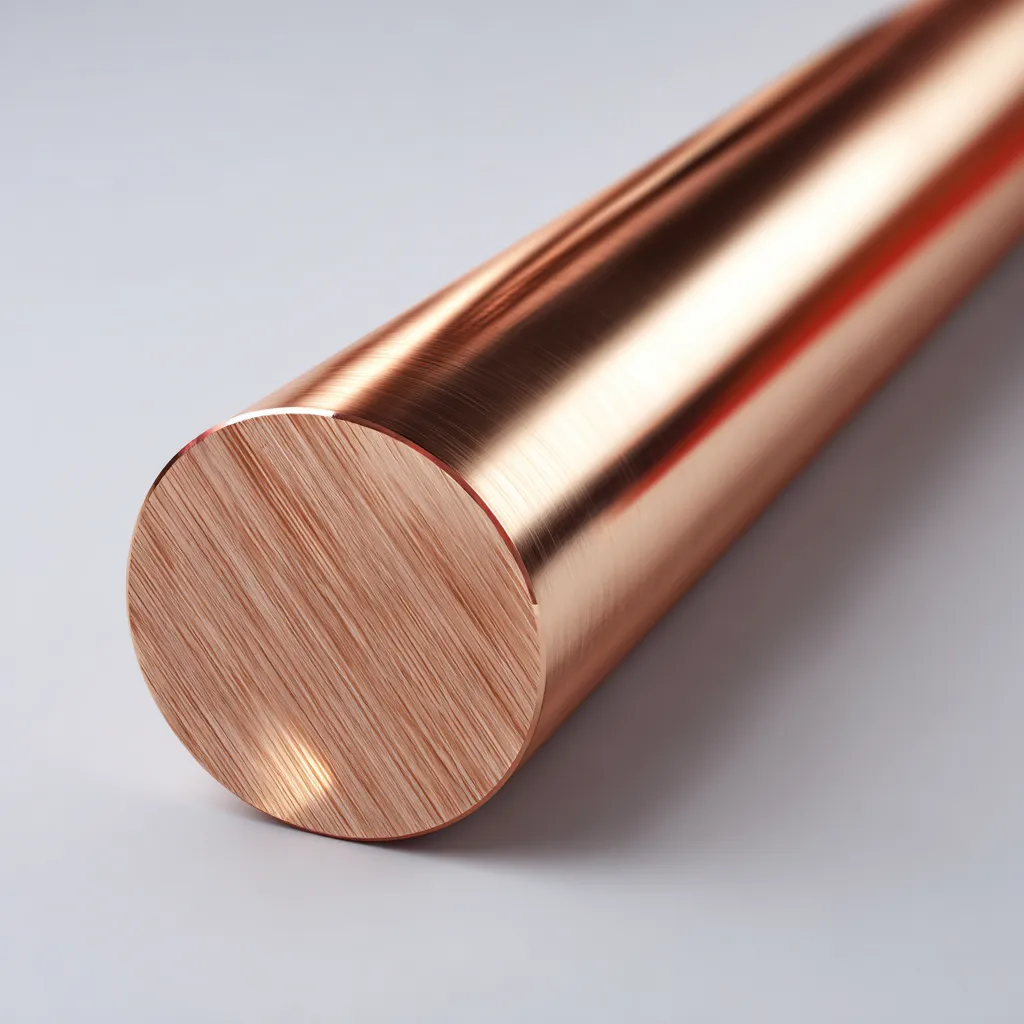
Electrolytic Tough Pitch Copper (C11000) is electrolytically refined pure copper with a minimum purity of 99.90% Cu. It is the reference material for electrical conductivity, with a typical value of 101% IACS, making it the industry standard for applications requiring maximum current conduction with minimal losses. ALCAVIL supplies it in H02 (Half Hard) temper, the industry standard for its optimal balance of mechanical strength, conductivity, and machinability.
The ETP (Electrolytic Tough Pitch) designation indicates a controlled oxygen level (~0.02-0.04%) that improves mechanical properties without significantly affecting conductivity. The IACS standard was defined in 1914 as a fixed resistivity reference. C11000 ETP achieves 101% IACS, meaning it slightly exceeds that original standard. When an alloy is rated at "75% IACS", it is compared against that fixed reference, not directly against C11000.
Technical Specifications
| Property | Value | Unit |
|---|---|---|
| UNS Designation | C11000 | - |
| Type | ETP (Electrolytic Tough Pitch) | - |
| Composition | ≥99.90% Cu | % wt |
| Electrical Conductivity | 101 | % IACS |
| Hardness | ~35-45 | HRB (H02 Half Hard) |
| Thermal Conductivity | 391 | W/m·K |
| Melting Point | 1083 | °C |
| Softening Temperature | 200 | °C |
| Tensile Strength | 255-317 | MPa (H02 Half Hard) |
| Density | 8.89-8.94 | g/cm³ |
Primary Applications
Why Electrolytic Copper for Busbars and Shunts
In resistance welding, the current that creates the weld doesn't only pass through the electrodes — it flows through the entire secondary circuit: transformer, cables, shunts, arms, and platens. Every component in that circuit must have the lowest possible resistance to avoid energy losses.
- Maximum conductivity (101% IACS) — No other material conducts electricity better. Every percentage point of IACS you lose becomes wasted heat in the circuit.
- Lowest electrical resistance — More current reaches the weld zone and less is lost along the way.
- Excellent thermal conductivity (391 W/m·K) — Dissipates heat generated at connections and joints, preventing hot spots.
- Good machinability — Can be easily cut, drilled, and machined to fit specific machine configurations.
Practical rule: Everything that is not an electrode in the secondary circuit should be electrolytic copper. Electrodes need hardness (Class 2, 3), but busbars, shunts, and arms need maximum conduction.
Available Forms
- Round bars — Diameters from 1/4" to 6" and larger. For circular busbars, conductor shafts, and machined parts.
- Plates and flats — Thicknesses from 1/8" to 2" and more. For flat busbars, connection platens, and conductor bases.
- Square bars — Sections from 1/2" to 4". For welder arms and structural conductor components.
All forms available in custom cut sizes. Contact us for specific dimension availability.
When NOT to Use Electrolytic Copper (and What to Use Instead)
Electrolytic copper is for conduction, NOT for welding electrodes.
❌ Don't use C11000 if:
- You need welding electrodes — C11000 is too soft (~35-45 HRB at H02) and softens at 200°C. Electrodes need harder alloys like Class 2.
- Sustained temperatures above 150°C — C11000 loses its temper quickly. Use Class 2 (C18200) which resists up to 475°C.
- You need wear resistance — Pure copper's low hardness won't resist repeated friction or impact. Consider hardened alloys.
- Direct contact with the weld zone — Any component touching the workpiece needs hardness, not just conductivity.
✓ Use this instead:
- Class 1 (C15000) — If you need high conductivity BUT also hardness for electrodes (galvanized applications).
- Class 2 (C18200) — The standard for electrodes. Good conductivity (75% IACS) with excellent hardness.
- Class 3 (C17510) — If you need maximum hardness for UHSS, projection, or high-pressure welding.
⚡ Quick Checklist (30 sec):
Quick rule: Electrolytic = conduction (busbars, shunts, arms). RWMA alloys = workpiece contact (electrodes).
Not sure if you need electrolytic copper or an RWMA alloy? Tell me what part you need and I'll recommend the right material.
Request technical recommendation →Electrolytic Copper vs. RWMA Alloys
Many customers ask us: "Why not use pure copper for everything?" The answer lies in the balance between conductivity and hardness:
- Electrolytic Copper (C11000): Maximum conductivity (101% IACS), but low hardness (~35-45 HRB at H02) and softens at 200°C. Perfect for components that conduct current without mechanical contact with the workpiece.
- RWMA Alloys: Sacrifice some conductivity (60-80% IACS) to gain hardness (65-100+ HRB) and heat resistance. Necessary where there is friction, pressure, and temperature.
In a resistance welding circuit, both materials work together: electrolytic copper conducts current with minimal losses to the electrodes, and RWMA alloys withstand direct contact with the workpiece.