

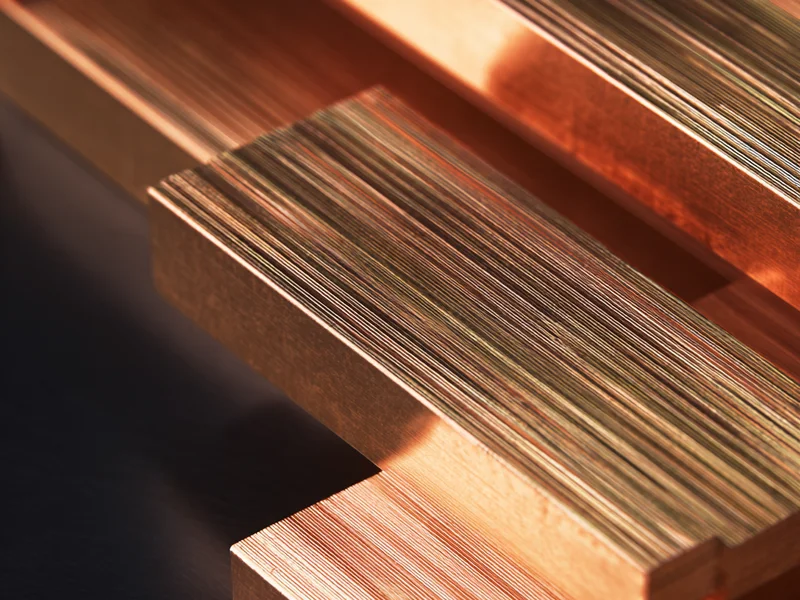
AWS J1.3 Technical Specifications
| Property | Value | Unit |
|---|---|---|
| UNS Designation | C17200 | - |
| Composition | Cu + 1.8-2.0% Be + 0.2% Co | % wt |
| Electrical Conductivity | ≥22 | % IACS (AWS J1.3 min) |
| Hardness | ≥33 | HRC (AWS J1.3 min) |
| Tensile Strength | 1100-1400 | MPa |
| Softening Temperature | 650 | °C |
| Elastic Modulus | 128 | GPa |
Important - Hardness in HRC: Unlike Classes 1, 2 and 3 measured in HRB, Class 4 is measured in Rockwell C (HRC) due to its extreme hardness. 42 HRC is comparable to hardened steel.
Specific Applications
Injection Molds Rapid cooling inserts
Bases and Holders High-pressure electrode holders
Flash Welding Dies Structural tooling
Welding Fixtures Locating components
Class 3 vs Class 4: The Critical Difference
Both classes contain beryllium, but have completely different purposes:
| Property | Class 3 (CuNiBe C17510) | Class 4 (CuBe C17200) |
|---|---|---|
| Conductivity | 45-60% IACS | 22-25% IACS |
| Hardness | 96-102 HRB | 36-42 HRC |
| Primary Use | Direct contact electrodes | Molds, fixtures, dies, tooling |
| Balance | Conductivity + Hardness | Maximum hardness, lower conductivity |
Class 3 maintains sufficient conductivity to be the contact electrode. Class 4 sacrifices conductivity for maximum mechanical strength, used in components that are not the main electrode.
Safe Handling Note: Beryllium alloys in solid bar or plate form are completely safe to handle, transport and store. Potential risk exists only during machining if dusts or fine chips are generated, requiring proper extraction systems and specific protocols. ALCAVIL supplies material in solid form and can machine it under safety protocols certified per OSHA 1910.1024. Download the Safe Handling Guide
Important: Class 4 is NOT for electrodes
It's common for Class 4 to be confused with an electrode material for resistance welding. It's not.
- If you're looking for welding electrodes: Class 4 is not what you need. Use Class 1, Class 2 or Class 3 depending on your application.
- Conductivity is too low: With only 22% IACS, Class 4 doesn't conduct enough current to be an effective electrode.
- It's much more expensive: The high beryllium content (1.8-2.0%) makes it significantly more costly than other classes.
Class 4 is designed for tooling, molds and inserts where extreme hardness and heat transfer are needed, but not main electrical current conduction.
What We See in Real Applications
In our experience:
- Plastic injection molds: This is where Class 4 is most used. The combination of hardness and thermal conductivity allows rapid cooling cycles.
- Mold inserts: Specific areas that require accelerated cooling or wear resistance.
- Tooling and fixtures: Structural components that need to withstand mechanical loads without deformation.
- Common confusion: Sometimes we receive requests for "Class 4 for electrodes" - we always validate the application because almost always what they need is Class 2 or 3.
If you're unsure which class you need, let's discuss your application to recommend the right material.